
Cisco Catalyst 9200 vs 9300: Which Enterprise Switch Is Right for You Business?
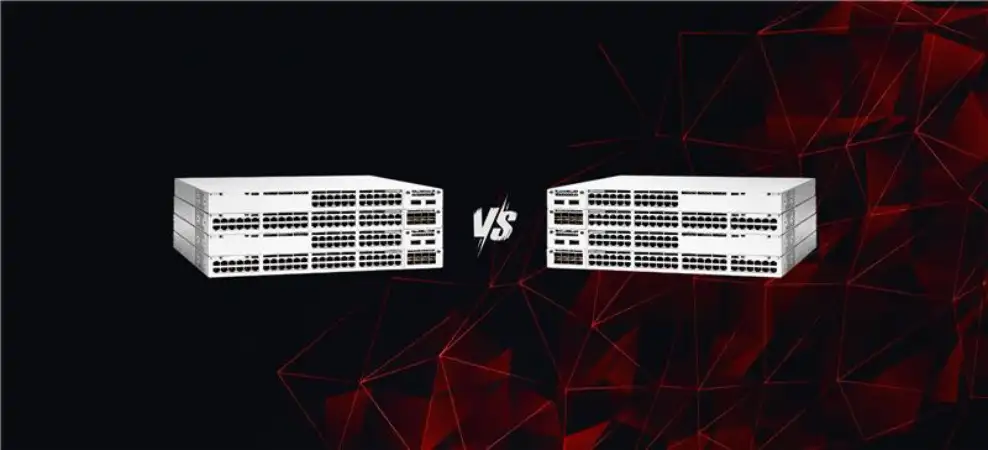
Compare Cisco Catalyst 9200 & 9300 switches for PoE, ports, scalability, Wi-Fi 6, and enterprise needs.
Choosing the right access-layer switch is one of the most critical decisions in an enterprise network design or refresh. Among Cisco’s access switches, Cisco Catalyst 9200 and Cisco Catalyst 9300 are the most commonly compared models because they share the same Catalyst 9000 architecture but are built for very different network sizes, workloads, and long-term goals.
This guide provides a clear, real-world comparison of Cisco Catalyst 9200 vs 9300, helping IT teams, network engineers, and buyers select the right switch based on performance, PoE requirements, scalability, and budget.
Cisco Catalyst 9200 is best suited for SMBs and branch offices that need reliable PoE+ and 10G uplinks at a lower cost, while Cisco Catalyst 9300 is designed for enterprise campus networks that require multigigabit ports, higher PoE power, and uplinks up to 100G.
Quick Comparison: Catalyst 9200 vs Catalyst 9300
| Feature | Catalyst 9200 Series | Catalyst 9300 Series |
| Target Environment | SMB, branch, mid-size offices | Enterprise campus, large offices |
| Access Ports | 24 / 48 × 1G | 24 / 48 × 1G & Multigig |
| PoE Support | PoE+ (30W per port) | PoE+, UPOE, UPOE+ (up to 90W) |
| Stacking Bandwidth | Up to 160 Gbps | 480 Gbps to 1 Tbps |
| Uplink Options | 1G / 10G / 25G | 1G / 10G / 25G / 40G / 100G |
| SD-Access | Basic | Full |
| Lifecycle | Mid-term | Long-term |
| Price Tier | Lower | Higher |
Decision Summary:
- Cost-efficient, stable networks → Catalyst 9200
- High-growth, future-proof networks → Catalyst 9300
What Is the Cisco Catalyst 9200 Series?
The Cisco Catalyst 9200 Series is an enterprise access-layer switch designed for cost-efficient, secure networking in SMBs and branch environments.
The Catalyst 9200 replaces legacy models such as the Catalyst 2960-X/XR and introduces Cisco IOS XE, automation, and enhanced security at a lower entry cost into the Catalyst 9000 family.
Key Strengths of Catalyst 9200
- Affordable enterprise-grade switching
- PoE+ (30W) support for access devices
- StackWise-80 / StackWise-160
- Cisco IOS XE with CLI and Catalyst Center
- Lower power consumption and quieter operation
Best Use Cases
Catalyst 9200 is ideal if:
- You are upgrading from older 2960 switches
- Your access layer is primarily 1G
- You are deploying Wi-Fi 6 (not 6E)
- Budget efficiency matters more than maximum scalability
What Is the Cisco Catalyst 9300 Series?
The Cisco Catalyst 9300 Series is Cisco’s flagship enterprise access switch platform, built for high-density campus networks requiring advanced PoE, multigigabit access, and long-term scalability.
The Catalyst 9300 replaces the Catalyst 3650 and 3850 series and is designed to support modern enterprise demands such as Wi-Fi 6E, IoT, and high-speed uplinks.
Key Strengths of Catalyst 9300
- Extremely high stacking bandwidth (up to 1 Tbps)
- PoE+, UPOE (60W), and UPOE+ (90W)
- Multigigabit access ports
- Uplinks up to 100G QSFP28
- Full SD-Access and segmentation support
- Longer product lifecycle and future readiness
Best Use Cases
Catalyst 9300 is the right choice if:
- You manage a large campus or enterprise network
- You expect growth in users, devices, and traffic
- You deploy high-power devices (PTZ cameras, Wi-Fi 6E)
- You want to avoid hardware replacement in 5–7 years
PoE Comparison: Catalyst 9200 vs 9300
PoE capability is one of the most important differences between Catalyst 9200 and Catalyst 9300.
Catalyst 9200 PoE
- Supports PoE+ (30W per port)
- Suitable for:
- Standard Wi-Fi 6 access points
- IP phones
- Fixed IP cameras
Catalyst 9300 PoE
- Supports PoE+, UPOE (60W), and UPOE+ (90W)
- Designed for:
- Wi-Fi 6E access points
- Outdoor and PTZ cameras
- IoT and building automation
Why this matters:
Underpowered PoE switches often force early upgrades. If future devices may require more power, Catalyst 9300 provides significantly more headroom.
Performance and Scalability
| Capability | Catalyst 9200 | Catalyst 9300 |
| Switching Capacity | Up to ~160 Gbps | 640+ Gbps |
| Stack Size | Up to 8 switches | Up to 8 switches |
| Routing Scale | Limited | Much higher |
| Lifecycle Expectation | Mid-term | Long-term |
Catalyst 9300 is better suited for environments with high user density, heavy traffic, and long-term expansion plans, while Catalyst 9200 meets the needs of stable, predictable networks.
Catalyst 9200 vs 9300 for Wi-Fi 6 and Wi-Fi 6E
- Wi-Fi 6:
- Catalyst 9200 PoE+ is usually sufficient.
- Wi-Fi 6E / Wi-Fi 7:
- Catalyst 9300 is strongly recommended due to multigig ports and higher PoE output.
Wireless performance is often limited by switch backhaul and power availability. Catalyst 9300 removes these bottlenecks.
Catalyst 9200 vs 9300: Which Is Better?
Choose Cisco Catalyst 9200 if:
- You want enterprise reliability at a lower cost
- Your network requirements are clearly defined
- You do not need multigig or UPOE
- You are deploying in branches or mid-size offices
Choose Cisco Catalyst 9300 if:
- You are building a future-proof enterprise network
- You expect growth in users, devices, or bandwidth
- You plan to deploy Wi-Fi 6E, cameras, or IoT
- You want maximum lifecycle value
Looking to Buy Cisco Catalyst Switches?
ITDBAY offers a wide selection of Cisco Catalyst 9200 and 9300 switches, including PoE and enterprise campus models. Our networking specialists can help you select the right configuration based on ports, PoE budget, and uplink requirements.
- View Cisco Catalyst Switches
- Request a Quote from ITDBAY
Frequently Asked Questions
What is the difference between Cisco Catalyst 9200 and 9300?
The Catalyst 9200 is designed for SMB and branch networks with PoE+ and 10G uplinks, while the Catalyst 9300 is built for enterprise campuses with higher performance, advanced PoE, and uplinks up to 100G.
Is Cisco Catalyst 9300 better than 9200?
Yes, the Catalyst 9300 offers greater scalability, higher PoE capacity, and multigigabit support. However, Catalyst 9200 is more cost-effective for smaller networks.
Is PoE+ enough for Wi-Fi 6?
Yes. Most Wi-Fi 6 access points operate efficiently on PoE+ (30W), which is supported by Catalyst 9200 switches.
What switch do I need for 30 IP cameras?
A 48-port Catalyst 9200 PoE switch is sufficient for standard cameras. For PTZ or outdoor cameras, Catalyst 9300 with UPOE is recommended.
What is the difference between SFP, SFP+, and QSFP28?
SFP supports 1G speeds, SFP+ supports 10G, and QSFP28 supports up to 100G, commonly used in enterprise uplinks.
Final Recommendation
If your network is infrastructure you expect to rely on for the next 7–10 years, the Cisco Catalyst 9300 is typically the better long-term investment.
If you need enterprise-grade switching at the lowest possible cost, the Cisco Catalyst 9200 delivers excellent value without unnecessary complexity.
RECENT BLOG POSTS
CATEGORIES
- Laptop Comparisons
- Cisco Switches
- Laptop Comparisons
- Cisco Switches
Contact Us
Send us a Message
Fill out the form below to get started, and a member of our team will contact you as soon as possible