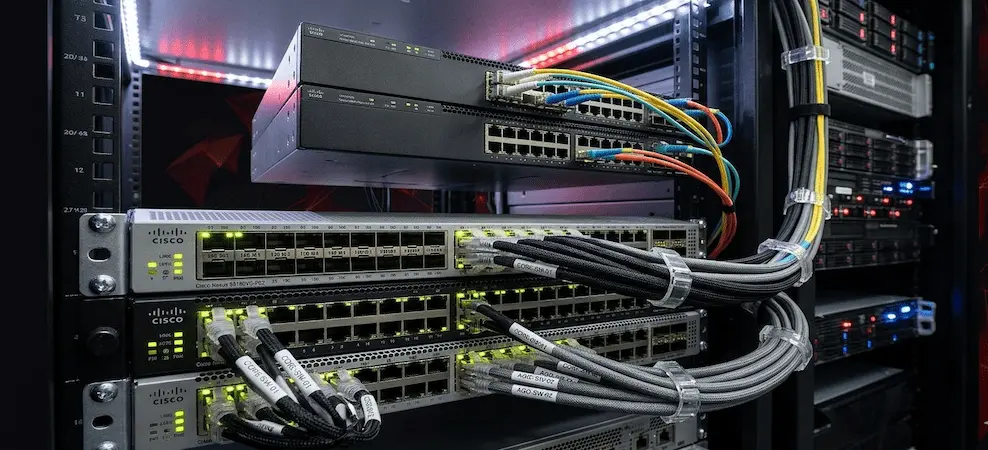
Learn Cisco Nexus 9000 FX2 Series architecture, real use cases, and FX vs FX2 vs FX3 model differences.
Modern data centers demand high bandwidth, predictable latency, and scalable architectures to support cloud computing, virtualization, AI workloads, and storage‑intensive applications. The Cisco Nexus 9000 FX2 Series is designed to meet these requirements by delivering high‑performance switching optimized for spine‑leaf data center architectures.
As an evolution of the Nexus FX platform, the FX2 series improves buffer efficiency, telemetry, and scale, making it a popular choice for enterprises and service providers building next‑generation networks.
The Cisco Nexus 9000 FX2 Series is part of Cisco’s fixed‑configuration data center switching portfolio. These switches are purpose‑built for high‑density Layer 2 and Layer 3 switching, offering consistent performance for east‑west traffic patterns commonly seen in modern data centers.
FX2 switches support advanced features such as:
These capabilities make FX2 models ideal for scalable, low‑latency environments.
The FX2 architecture focuses on improving performance and scale over previous FX models. Key architectural enhancements include:
This architecture allows FX2 switches to operate efficiently in both spine and leaf roles, depending on deployment requirements.
The Cisco Nexus FX2 Series is widely deployed across multiple data center scenarios:
FX2 switches are frequently used as spine switches, providing high‑bandwidth interconnection between leaf switches with consistent low latency.
Organizations use FX2 switches to modernize core and aggregation layers, supporting virtualization platforms and private cloud environments.
With strong Layer 3 capabilities and automation support, FX2 switches are suitable for multi‑tenant and large‑scale cloud infrastructures.
AI, machine learning, and storage‑intensive applications benefit from the predictable performance and high throughput of FX2 platforms.
When selecting a Cisco Nexus 9000 switch, understanding the differences between FX generations is critical:
For many organizations, the FX2 series provides the best balance between performance, features, and cost, making it a widely adopted option.
Several FX2 models are commonly used depending on deployment needs. One example is the
Cisco Nexus N9K‑C9336C‑FX2 is often selected for spine deployments in high‑density data centers due to its performance and scalability.
Different FX2 models are available to support varying port speeds, densities, and deployment roles, allowing network architects to design flexible infrastructures.
The Cisco Nexus 9000 FX2 Series is ideal for organizations that need:
By adopting FX2 switches, businesses can build reliable, future‑ready data centers that support growth and evolving workloads.
The Cisco Nexus 9000 FX2 Series represents a significant step forward in data center networking. With its enhanced architecture, versatile use cases, and strong performance characteristics, FX2 switches are a solid choice for enterprises and service providers alike.
When designing or upgrading a data center network, evaluating FX2 models alongside specific workload requirements ensures the right balance of performance, scalability, and investment protection.
The Cisco Nexus 9000 FX2 Series is a family of high‑performance data center switches designed for modern spine‑leaf architectures. These switches support advanced Layer 2 and Layer 3 networking with improved buffering, telemetry, and scalability compared to earlier FX models.
FX2 switches enhance the original FX platform by offering better buffer efficiency, higher scale, and improved visibility through advanced telemetry. This makes FX2 switches more suitable for cloud, virtualization, and high‑traffic data center environments.
Cisco Nexus FX2 switches are commonly deployed as spine or aggregation switches in enterprise data centers, cloud environments, and service provider networks that require predictable low latency and high throughput.
Yes, the FX2 Series is specifically optimized for spine‑leaf data center designs, providing consistent performance and scalability for east‑west traffic flows between leaf switches.
FX3 models provide additional performance improvements for next‑generation workloads, while FX2 switches offer an excellent balance of performance, features, and cost for most enterprise and cloud data center use cases.
A popular FX2 model used in high‑density data center deployments is the Cisco Nexus N9K‑C9336C‑FX2, often selected for spine roles due to its scalability and performance.
Fill out the form below to get started, and a member of our team will contact you as soon as possible